Calibration & Control
Fuel mapping theory
Preserved guidance from the old troubleshooting manual explaining raw pulse-width resolution and how it differs from volumetric-efficiency fuelling.
Pulse-width mode
In pulse-width mode the Main Injection Quantity map is a 0–255 table representing 0–100% of the configured maximum injection pulse width. Each raw step is therefore about 0.392% of the maximum. If that step size produces too much fuel change at low load, the configured maximum pulse width is too large for the required resolution.
Choose a maximum pulse width that still permits the required full-load fuel quantity while retaining useful low-load resolution. Turbo/supercharged applications may use MAP-compensated strategies where supported so boost fuel demand does not force unnecessarily coarse low-load resolution.
Volumetric-efficiency mode
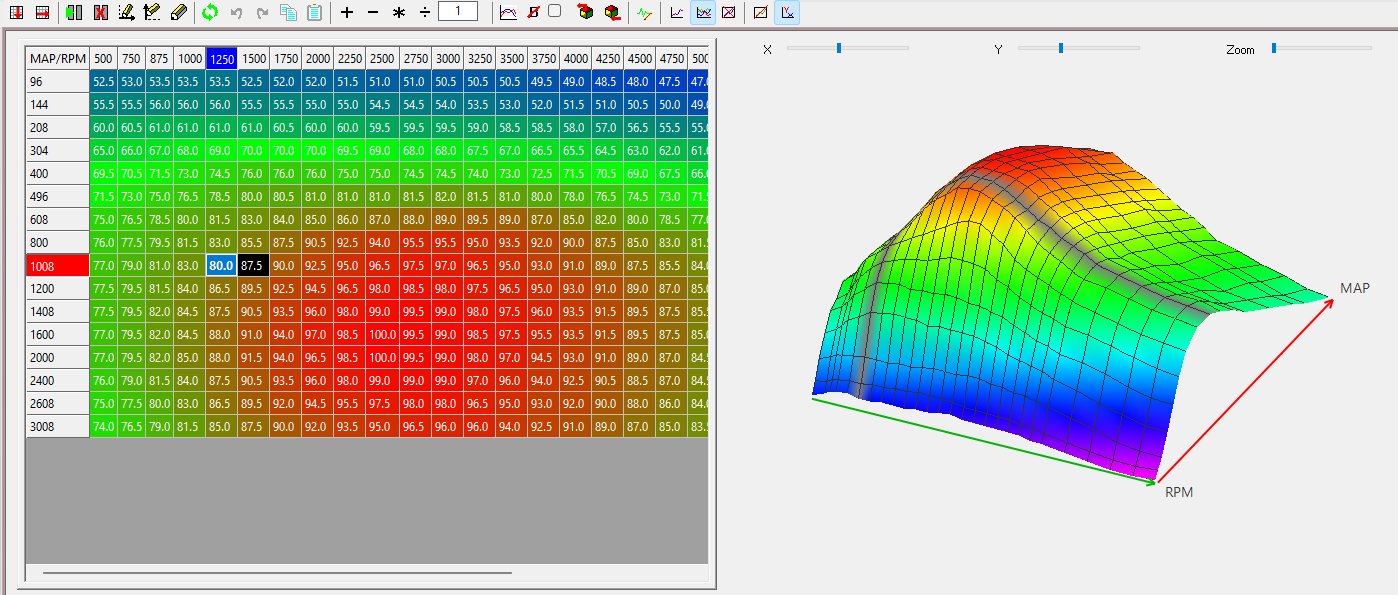
Where the ECU is configured for VE/speed-density operation, the main fuel table represents volumetric efficiency and the fuel calculation also uses manifold pressure, temperature, injector flow and target lambda. This produces a different calibration model from the raw pulse-width strategy.
Map quality
Whichever strategy is used, keep the base map smooth and physically plausible. Closed-loop lambda should correct small residual errors rather than compensate for a badly shaped base calibration.