
Calibration & Control
Acceleration and deceleration fuelling
Use throttle-rate based transient fuelling to correct mixture during rapid throttle movement.
How it works
The ECU measures the change in throttle position over the configured TPS Transient Timer. A positive change can generate acceleration enrichment; a negative change can generate deceleration enleanment. The calculated term is scaled into an injection pulse-width correction and then modified by coolant-temperature, engine-speed and decay maps.
Main controls
Transient Fuel Pulse Width Scaler is the overall size control. The positive and negative dTPS trigger values determine how much throttle movement is required before correction starts, while the clamp values limit the largest delta used by the calculation. The decay timer and decay maps determine how quickly the correction disappears.
Calibration approach
- Get steady-state fuel calibration correct first.
- Use logged TPS/dTPS and lambda response to identify genuine transient lean/rich events.
- Set trigger thresholds high enough to avoid correction from sensor noise or tiny pedal movements.
- Adjust the overall scaler and temperature/RPM multipliers before making the decay excessively long.
- Check both acceleration and throttle-lift behaviour over the temperature and RPM range.
SXTune screens
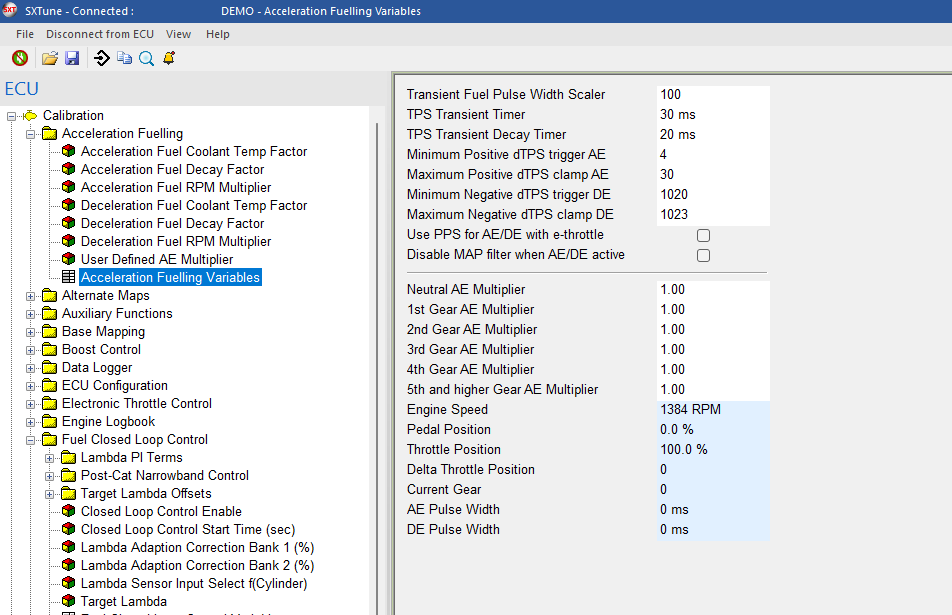
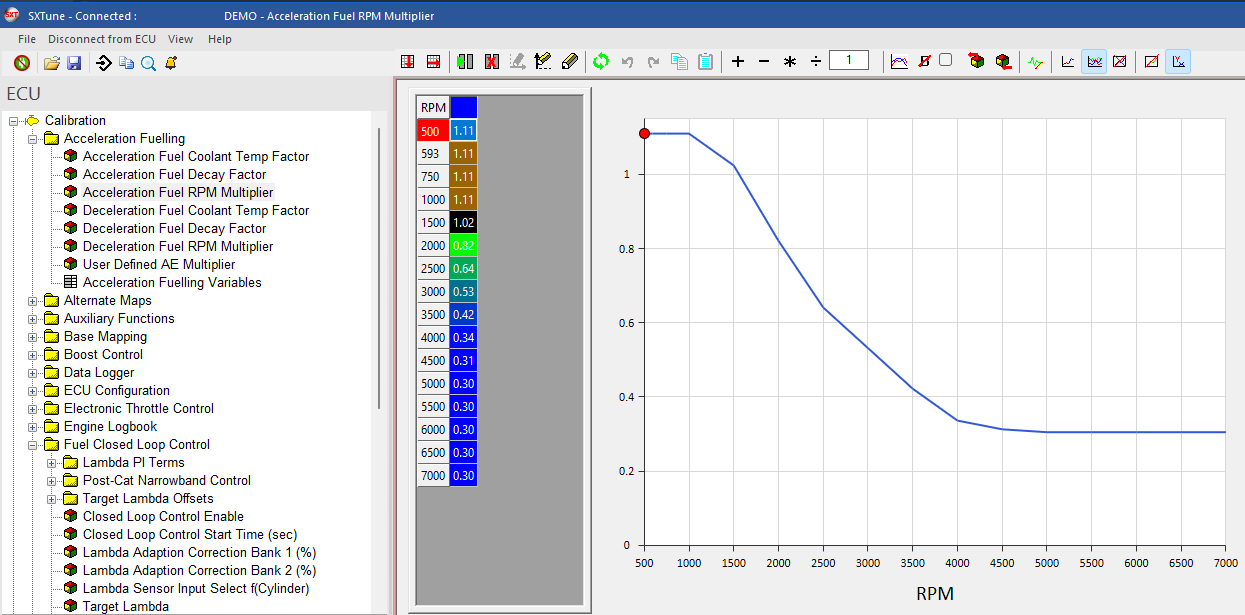
The Acceleration Fuelling Variables page shows the live transient values together with the editable timer, trigger, clamp and gear multiplier settings. The RPM multiplier provides engine-speed correction.
Acceleration fuelling strategy
Acceleration fuelling is calculated by measuring a change in throttle angle (delta TPS) or change in manifold pressure (delta MAP) and is using this term multiplied by a global scaling factor and coolant temperature and engine speed compensations to generate an injection pulse width term that is added to the final injection pulse width. The diagram below shows the operation of the transient fuelling enrichment.

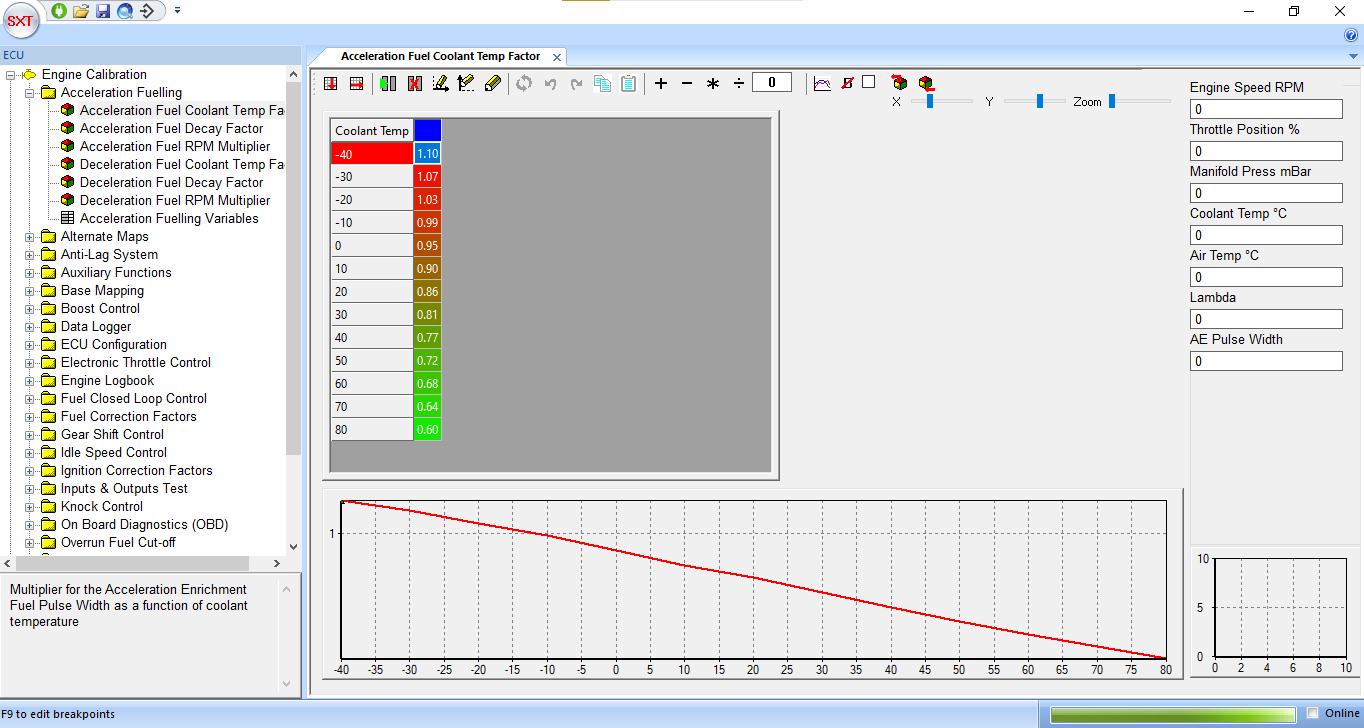
Image: table for the coolant depending acceleration enrichment factor as
calibrated on the
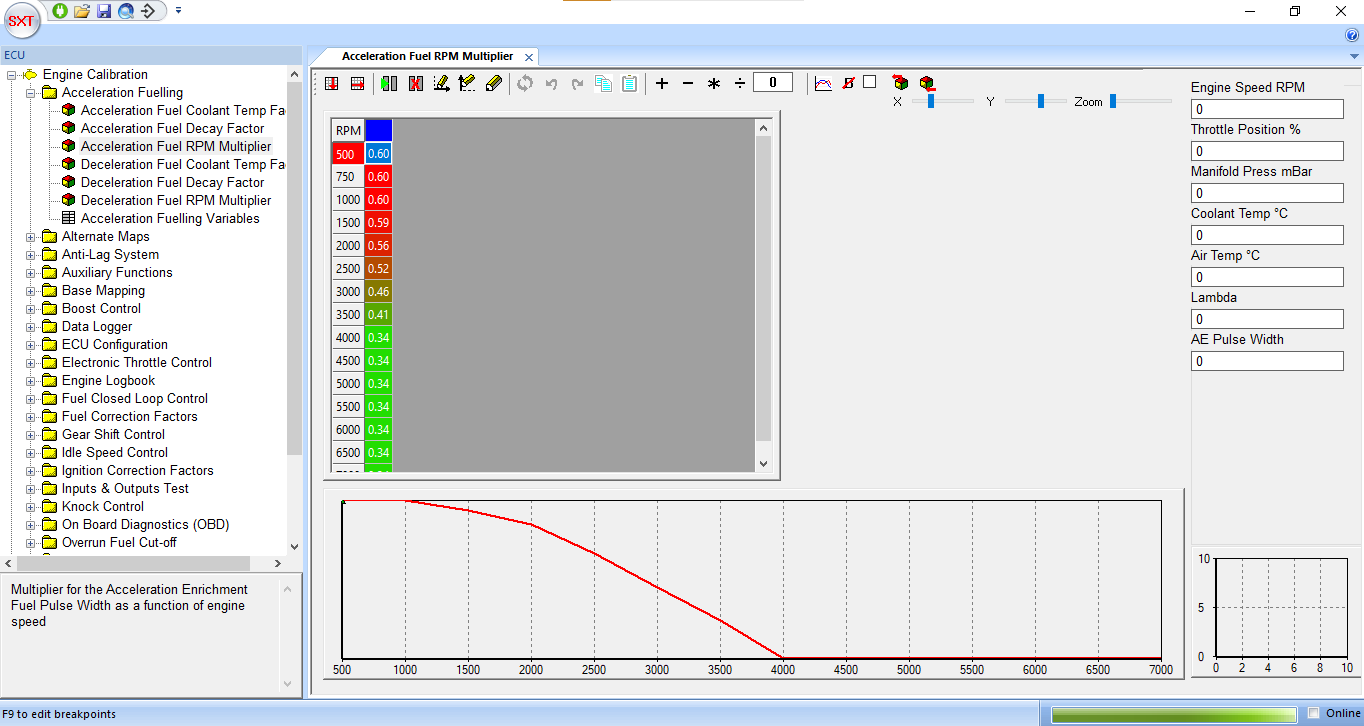
Image: table for the engine speed depending acceleration enrichment
factor as calibrated on the
The acceleration fueling value is multiplied by the ‘Acceleration Fuel Coolant Temp Factor’ map which is a function of coolant temperature as cold engines require more acceleration enrichment. The value is also multiplied by the ‘Acceleration Fuel RPM Multiplier’ map which allows the acceleration enrichment to be varied with engine speed, typically less enrichment is required at higher engine speeds.
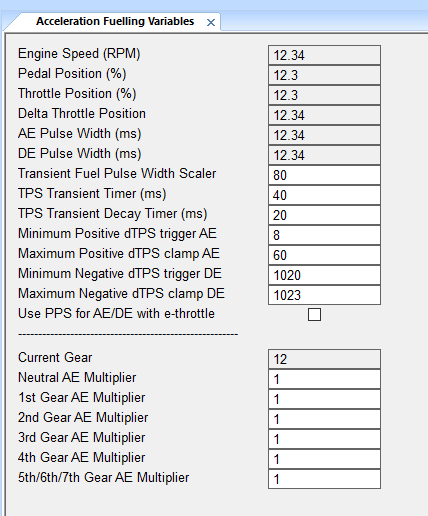
Image: overview table for the acceleration enrichment settings as
calibrated on the
The acceleration fuelling variables page contains the variables listed below:
Engine Speed - DE pulse Width -The first 6 are None user editable field showing live values
Transient Fuel Pulse Width Scaler – the global scaler for acceleration fuelling
TPS Transient Timer – Timer (in milliseconds) over which the delta TPS value is calculated (see strategy illustration)
TPS Transient Decay Timer – Timer (in milliseconds) which determines rate of acceleration enrichment term decay
Minimum positive dTPS trigger AE – The minimum limit to enable acceleration fuelling calculation
Maximum positive dTPS clamp AE – The maximum saturation limit of the acceleration enrichment calculation
Minimum Negative dTPS trigger AE – The minimum limit to enable deceleration fuelling calculation
Maximum Negative dTPS clamp AE – The maximum saturation limit of the deceleration enleanment calculation